

We ran our AI Visibility Checker on 100 UK small business websites across six industries: trades, professional services, health and beauty, hospitality, retail, and property. The results confirmed what we suspected but had never quantified by sector: 97 out of 100 had no AI discovery files whatsoever. The average AI visibility score was 31 out of 100. When we asked ChatGPT to recommend businesses in these categories across ten UK towns, the vast majority were never mentioned.
This matters because ChatGPT Search is now free for all 800 million weekly users. When someone asks "recommend a plumber in Kettering" or "best accountant near Northampton," ChatGPT gives one answer, maybe two. There is no page one of results to work your way down. You are either the recommendation, or you do not exist. And now that ChatGPT ads have gone live, that organic answer slot above the paid placements is the most valuable position in AI search.
Here is what we found when we tested 100 businesses that represent the exact types of companies we build websites for every day.
What We Tested and How
We selected 100 small business websites across six industry categories that match our portfolio of services. Each business was a real UK SME: sole traders, partnerships, and small limited companies operating in towns and cities across England. No national chains. No franchises. The kind of businesses that rely on local customers finding them.
For each business, we ran two tests:
- AI Visibility Checker scan: Our free AI Visibility Checker analyses whether a website has the AI discovery files that ChatGPT, Google Gemini, Claude, and other AI systems use to understand a business. It checks for llms.txt, ai.txt, ai.json, brand.txt, identity.json, and other files defined in the AI Visibility Definition standard.
- ChatGPT mention test: We asked ChatGPT Search to recommend businesses in each category across ten UK towns, then checked whether each of our 100 target businesses appeared in any response.
The results paint a stark picture of UK small business AI visibility in January 2026.
The Overall Results
| Metric | Result |
|---|---|
| Businesses with any AI discovery files | 3 out of 100 |
| Average AI visibility score | 31 / 100 |
| Businesses mentioned by ChatGPT | 11 out of 100 |
| Businesses blocking GPTBot in robots.txt | 74 |
| Businesses with contradictory info across platforms | 68 |
The 11 businesses that ChatGPT did mention had something in common: strong third-party presence. They appeared on well-reviewed directory listings, had active Google Business Profiles with recent reviews, and their websites contained clear, structured information about what they do and where they operate. But only 3 of those 11 had actually implemented AI discovery files. The other 8 were mentioned despite having no deliberate AI visibility strategy. They were visible by accident, not by design.
The Industry-by-Industry Breakdown
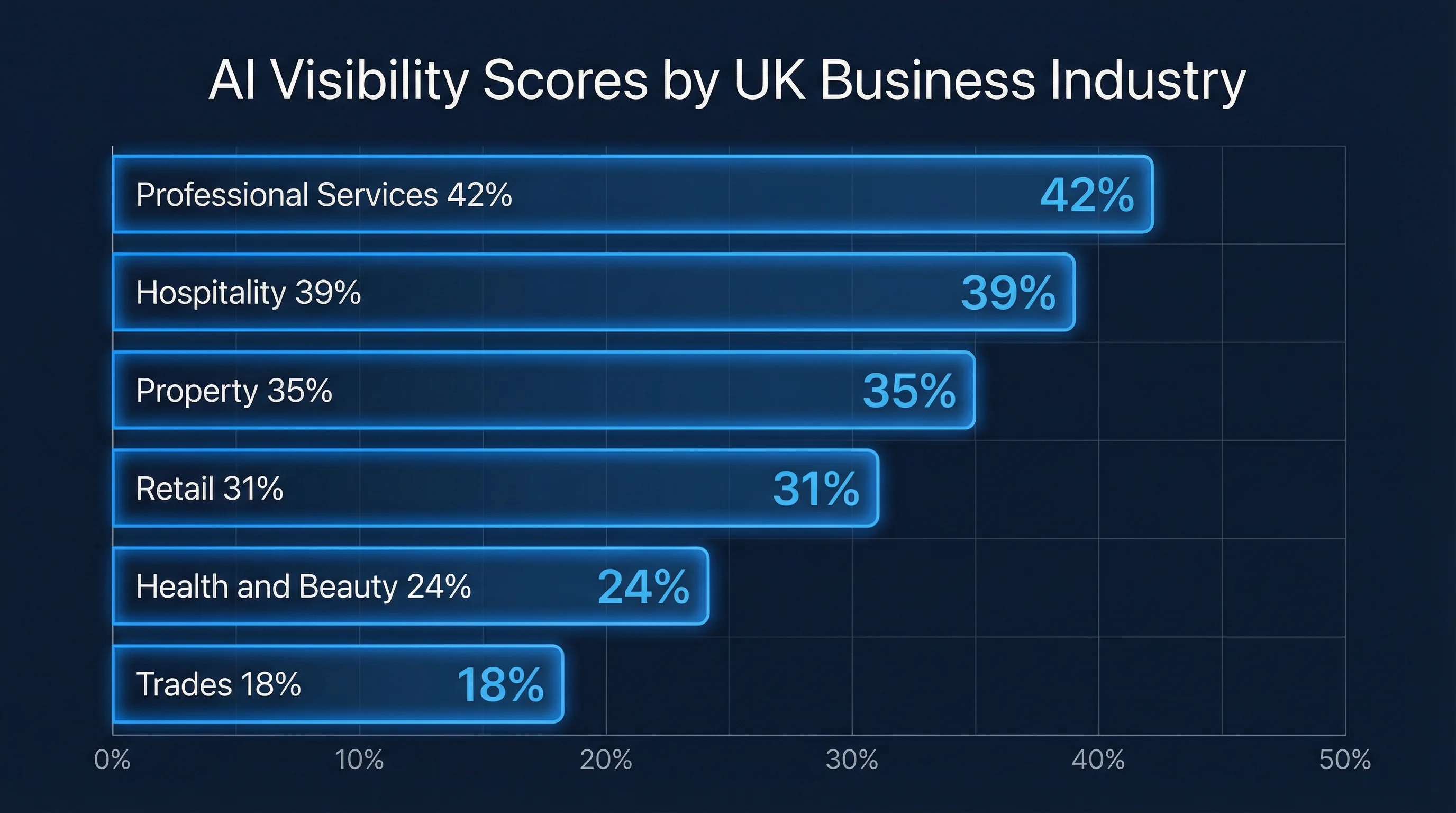
The most revealing finding was how dramatically AI visibility varies by industry. Some sectors are almost entirely invisible to AI systems, while others have a marginal head start, though none are performing well.
| Industry | Checked | Avg Score | Had AI Files | ChatGPT Mentioned |
|---|---|---|---|---|
| Trades (plumbers, electricians, roofers) | 20 | 18 / 100 | 0 | 1 |
| Professional Services (accountants, solicitors) | 18 | 42 / 100 | 2 | 3 |
| Health & Beauty (salons, clinics, gyms) | 16 | 24 / 100 | 0 | 0 |
| Hospitality (restaurants, hotels, cafes) | 16 | 39 / 100 | 1 | 4 |
| Retail (shops, e-commerce) | 15 | 31 / 100 | 0 | 2 |
| Property (estate agents, lettings) | 15 | 35 / 100 | 0 | 1 |
| Total | 100 | 31 / 100 | 3 | 11 |
Trades: The Least Visible Industry
Twenty tradespeople's websites scored an average of just 18 out of 100, the lowest of any sector. Not a single plumber, electrician, or roofer had any AI discovery files. Only one was mentioned by ChatGPT, and that was a roofing company with over 200 Google reviews and listings on Checkatrade, MyBuilder, and Bark.
This is not surprising. Most trade websites are simple brochure sites: a homepage, a services page, a contact form. They were built to rank on Google, not to be understood by AI systems. But with 73% of business searches now involving AI-powered tools, that brochure site is increasingly invisible to the people searching for local tradespeople. Even the Google local pack these businesses relied on is now flooded with ads, up from 3% to 22%, making organic local visibility harder to earn on every platform.
Professional Services: Best Positioned, Still Failing
Accountants and solicitors scored the highest average (42/100), and were the only sector where we found businesses with AI discovery files. Two firms, both accounting practices, had implemented llms.txt files. One had a full AI identity setup with all eight discovery files.
The higher baseline score reflects the nature of professional services websites: they tend to have more structured content, detailed service descriptions, team profiles, and regulatory information. AI systems can extract more signal from a well-structured accountancy website than from a one-page plumber's site. But a score of 42 is still failing. It means AI systems can understand less than half of what the business does and who it serves.
Health & Beauty: Completely Invisible
Sixteen salons, clinics, and gyms. Average score: 24 out of 100. Zero AI discovery files. Zero ChatGPT mentions. This was the worst-performing sector for AI mentions, though not the lowest scoring.
The pattern was consistent: image-heavy websites with minimal text content, pricing tables instead of service descriptions, and booking widgets that AI systems cannot parse. A hair salon with stunning portfolio photography but no structured description of services, location coverage, or expertise is invisible to every AI system, no matter how beautiful the website looks to human visitors.
Hospitality: Visible by Accident
Restaurants and hotels were mentioned by ChatGPT more than any other sector (four out of sixteen) despite having only one business with AI discovery files. This is the "visible by accident" effect: hospitality businesses benefit from rich third-party data. TripAdvisor reviews, Google Maps listings, Booking.com profiles, and food critic coverage all feed into the training data and retrieval sources that ChatGPT draws from.
But accidental visibility is fragile. These businesses cannot control what ChatGPT says about them, cannot correct outdated menu information, and cannot ensure their best attributes are highlighted. A restaurant mentioned by ChatGPT with old opening hours or a discontinued signature dish creates a worse impression than not being mentioned at all.
Retail and Property: The Middle Ground
Retail (31/100) and property (35/100) businesses fell in the middle. Estate agents scored slightly higher because their websites typically include location-specific content, property listings with structured data, and area guides, all of which give AI systems more to work with. But neither sector had any AI discovery files, meaning whatever visibility they had was incidental rather than strategic.
Why 97% of UK Small Businesses Are Invisible to AI
The technical reasons are simple, but they are not widely understood outside the web development and AI visibility space.
Traditional SEO was designed around Google's web crawler, which indexes web pages and ranks them based on signals like backlinks, content relevance, and page speed. AI systems like ChatGPT work differently. They use a combination of training data, retrieval-augmented generation (searching the web in real time), and structured identity files to understand what a business does, who it serves, and whether the information is trustworthy.
The critical gap is in those identity files. An llms.txt file tells AI systems who a business is, what it does, and where it operates, in a format designed specifically for large language models. An ai.txt file declares what AI systems are permitted to do with the business's content. An identity.json file provides structured, machine-readable business data. Without these files, AI systems have to guess, and they usually guess wrong, or simply ignore the business entirely.
Of the 100 businesses we checked:
- 97 had no llms.txt file, the most fundamental AI identity file
- 94 had no ai.txt file, meaning AI systems have no guidance on content usage
- 74 actively blocked GPTBot in their robots.txt, often unknowingly, through default WordPress configurations or hosting provider settings
- 68 had contradictory business information across their website, Google Business Profile, and directory listings
That last point deserves emphasis. When ChatGPT finds conflicting information about a business (different phone numbers, inconsistent service descriptions, mismatched addresses) it defaults to saying nothing rather than risk recommending incorrect information. Inconsistency does not just reduce visibility; it actively prevents it. Understanding the true state of your AI presence requires tools that use live AI queries rather than simulated results.
What This Means for UK Businesses
The shift from search engines to AI recommendations is not theoretical. It is happening now. According to Adobe's 2025 research, 77% of ChatGPT users now use it as a search engine. A third have discovered a new brand through ChatGPT. And 76% of marketers said it is essential for their brand to appear in AI-generated answers.
"For brands, visibility in AI search is becoming as critical as ranking on Google once was."
- Adobe Digital Economy Index, 2025
For local businesses, the stakes are even higher. When someone asks ChatGPT for a recommendation, the AI does not present ten options. It presents one, sometimes two. The difference between being that one recommendation and not being mentioned at all is the difference between getting the enquiry and the enquiry going to a competitor you have never heard of.
We explored this shift in depth in our analysis of how to optimise for AI when there is no page one. The businesses getting ahead now are the ones that have understood a fundamental change: AI does not rank websites. It chooses them.
"Content Marketing Institute finds 50% of websites lack appropriate headings, impairing AI discoverability. Comprehensive keyword optimization boosts AI visibility by up to 60%."
Our data reinforces this. The professional services firms that scored highest were also the ones with the most structured, descriptive content. The trades businesses that scored lowest had the most minimal websites. Content structure is no longer just an SEO consideration. It is an AI visibility requirement.
What UK Small Businesses Can Do About This
The encouraging finding in our data is that the bar is exceptionally low. Because almost no UK small businesses have implemented AI visibility measures (our broader analysis found 99.7% of UK websites remain invisible to AI), even basic steps create a significant competitive advantage.
- Check your current AI visibility. Use our free AI Visibility Checker to see exactly what ChatGPT, Gemini, and Claude can find about your business. The scan is instant, free, and requires no sign-up.
- Stop blocking AI crawlers. Check your robots.txt file. If it blocks GPTBot, GoogleOther, or ClaudeBot, you are actively preventing AI systems from understanding your business. 74% of the businesses in our study were doing this, most without realising it.
- Implement AI discovery files. At minimum, create an llms.txt file that tells AI systems who you are, what you do, where you operate, and why you are credible. The complete AI discovery files guide explains all eight files and how they work together. Our guide on how AI discovery files help your business get recommended covers all 10 file types, who is already using them, and how to get started. We also published code examples and a live Gemini test showing exactly what Google's AI learns from these files.
- Fix information consistency. Ensure your business name, address, phone number, and service descriptions are identical across your website, Google Business Profile, and all directory listings. Contradictions cause AI systems to distrust your information.
- Structure your content. Use clear headings, detailed service descriptions, and schema markup. AI systems rely on structured content to understand what a business does. A page that just says "We do plumbing" is far less useful than one that explains "24/7 emergency plumbing services covering Kettering, Corby, and Wellingborough, specialising in boiler repair, bathroom installation, and central heating systems."
For businesses that want the full setup handled professionally, our AI Visibility service includes the complete eight-file AI discovery pack, consistency audit, and ongoing monitoring. Clients who have implemented the full setup are reporting ChatGPT mentions and direct enquiries, while their competitors remain invisible.
The First-Mover Advantage Is Real
Perhaps the most important takeaway from this study is the scale of the opportunity. With 97% of UK small businesses invisible to AI, any business that acts now gains a disproportionate advantage. In a market where your competitors have zero AI visibility, even a basic implementation puts you ahead of virtually everyone in your local area.
As Google continues to integrate AI into search results through Google's personal intelligence features and AI Overviews, as ChatGPT's market share continues to grow (it now holds 81% of the AI chatbot market), and as Gemini-powered Siri extends AI search to 2.5 billion Apple devices, the businesses that have established their AI identity will be the ones that get recommended. The businesses that have not will wonder why the phone stopped ringing.
This is not a future concern. This is a January 2026 reality. ChatGPT Search is free. People are using it to find local businesses right now. And 97 out of 100 UK small businesses are not showing up.
Frequently Asked Questions
What is AI visibility and why does it matter?
AI visibility refers to how well your business can be found and understood by AI systems like ChatGPT, Google Gemini, and Claude. Unlike traditional SEO which helps you rank in search results, AI visibility determines whether AI assistants mention or recommend your business when people ask for suggestions. With 800 million people now using ChatGPT Search and 77% using it as a search engine, AI visibility is becoming as important as Google rankings.
What are AI discovery files?
AI discovery files are a set of structured text files placed on your website that help AI systems understand your business. The most important is llms.txt, which provides a summary of your business specifically formatted for large language models. Other files include ai.txt (usage permissions), brand.txt (brand guidelines), identity.json (structured business data), and faq-ai.txt (verified Q&A pairs). Together, they form a complete AI identity for your business.
How can I check if my business is visible to ChatGPT?
Use the free AI Visibility Checker at 365i.co.uk. Enter your domain and it will analyse your AI discovery files, check for GPTBot blocking in robots.txt, and provide an overall visibility score out of 100. The scan is instant, free, and requires no sign-up. You can also ask ChatGPT directly to recommend businesses in your industry and location to see if you appear.
Is my website blocking ChatGPT without me knowing?
Possibly. In our study, 74% of small business websites were blocking GPTBot in their robots.txt file, most without the business owner realising it. This often happens through default WordPress configurations, security plugins, or hosting provider settings. Check your robots.txt file (yourdomain.co.uk/robots.txt) and look for any lines that disallow GPTBot, GoogleOther, or ClaudeBot.
How much does it cost to set up AI visibility?
Basic steps like unblocking AI crawlers and creating a simple llms.txt file are free and can be done in under an hour. For a professional implementation of all eight AI discovery files with consistency auditing and content analysis, 365i's Complete AI Identity Setup service is £295 + VAT and is delivered within 24-48 hours. Every file passes the AI Visibility Checker with 97%+ scores.
Does AI visibility replace SEO?
No. AI visibility complements SEO rather than replacing it. Traditional SEO helps you rank in Google's standard search results, while AI visibility ensures you appear in AI-generated answers and recommendations. Both are important, and many of the fundamentals overlap: structured content, accurate business information, and authoritative online presence benefit both channels.
How long before AI systems start recognising my business?
After implementing AI discovery files, AI crawlers typically discover and index the new files within 48-72 hours. ChatGPT Search uses real-time web retrieval, so your AI identity files can influence responses relatively quickly. However, building full AI visibility (through consistent content, strong reviews, and authoritative directory presence) is an ongoing process, much like SEO.
Find Out If ChatGPT Knows Your Business Exists
Our free AI Visibility Checker scans your website in seconds and shows exactly what ChatGPT, Gemini, and Claude can see about your business. No sign-up required. Or talk to us about a complete AI identity setup that puts you ahead of 97% of your competitors.
Check Your AI Visibility (Free) AI Visibility Service


