
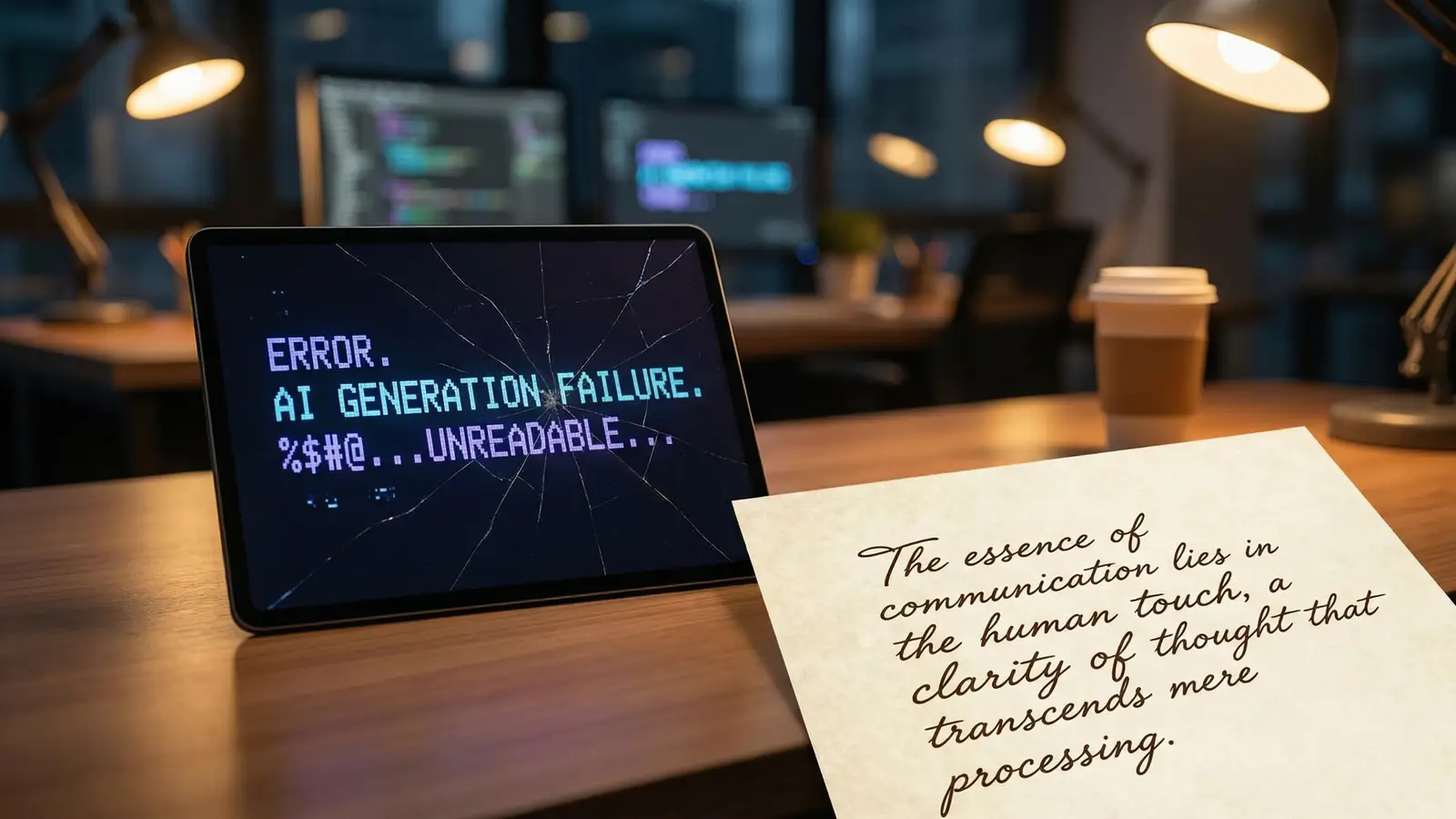
OpenAI CEO Sam Altman admitted on 27 January 2026 that the company "screwed up" writing quality in GPT-5.2, acknowledging that the model's output feels less natural, clear, and readable than its predecessor GPT-4.5. The admission, made during a developer town hall, confirms what users have been reporting for weeks: the latest flagship model writes worse than the one before it.
According to Search Engine Journal, Altman was blunt when asked about widespread user feedback that GPT-5.2 produces writing that is "unwieldy" and "hard to read" compared to GPT-4.5. His response ("I think we just screwed that up") is a rare public acknowledgement of a regression in a flagship AI product.
For UK businesses relying on AI tools for content creation, website copy, and customer communications, the admission raises a critical question: are you using the right AI tool for the right job?
What Altman Actually Said
During the developer town hall, Altman explained the writing regression as a deliberate trade-off in resource allocation. OpenAI put "most of our effort in 5.2 into making it super good at intelligence, reasoning, coding, engineering, that kind of thing," he said. The company has "limited bandwidth" and "sometimes we focus on one thing and neglect another."
The key quotes from Altman reveal the internal thinking:
- On the regression: "I think we just screwed that up. We will make future versions of GPT 5.x hopefully much better at writing than 4.5 was."
- On future direction: "The future is mostly going to be about very good general purpose models," suggesting even coding-focused models should "write well, too."
- On timeline: Altman expects "new models that are significant gains from 5.2 in the first quarter" of 2026, though no specific date for writing improvements was given.
As Gadgets 360 reported, the decline in stylistic fluency stems from what amounts to overtraining on technical tasks (mathematics, coding, and engineering) at the expense of natural language quality.

The Technical vs Writing Trade-Off
The numbers tell a clear story. GPT-5.2 dominates technical benchmarks: it is the first model to exceed 90% on ARC-AGI-1, achieves a perfect 100% on AIME 2025 mathematics, and scores 40.3% on FrontierMath, a 10% improvement over GPT-5.1. On GDPval, it matched or beat top industry professionals on 70.9% of well-specified tasks at 11 times the speed and less than 1% of the cost.
But benchmark dominance in coding and maths came at a measurable cost to writing. OpenAI's own system card acknowledges regressions in certain modes, with "Instant mode" showing notable quality dips compared to GPT-5.1.
Community feedback has been unsparing. One tester who expected a clean upgrade over GPT-5.1 reported that what they received "feels uneven, jumpy, and in places noticeably worse." Posts on OpenAI's developer forum describe users switching to competitors, with Anthropic's Claude and Google's Gemini cited as alternatives offering more natural writing. Our comparison of AI assistants versus Google shows how differently these platforms handle everyday queries.
This tension between technical capability and writing quality reflects a broader debate in the industry. Some argue that AI writing tools democratise clear communication; others worry they homogenise voice entirely. That argument recently played out on LinkedIn, where industry professionals clashed directly over whether AI writing represents progress or regression.

What This Means for Your Business Content
If your business uses AI to generate website copy, blog posts, email campaigns, or customer communications, this story carries a practical warning: the "latest" model is not always the best model for every task. And regardless of which model you use, you remain personally liable for what it produces.
The AI market has become increasingly specialised. Different platforms now excel in different areas:
| Task | GPT-5.2 Performance | Alternatives |
|---|---|---|
| Coding and engineering | Industry-leading (100% AIME, 90%+ ARC-AGI) | Claude Code also strong in this area |
| Scientific reasoning | Strong (38% fewer hallucinations than 5.1) | Gemini 3 competitive |
| Natural writing and content | Regressed from GPT-4.5 | Claude models maintain writing focus |
| Business communications | Reported as "unwieldy" | GPT-4.5 (still available), Claude |
This matters because poor AI-generated content does not just affect readability. It affects how AI systems themselves perceive your business. If your website copy reads as robotic or unnatural, it undermines both user trust and AI visibility. The same AI platforms that generate content also evaluate it when recommending businesses to users. And with ChatGPT now introducing advertising, the distinction between organic recommendations and paid placements makes content quality even more critical.
The trend towards specialisation is worth noting. As we reported when Claude Code hit its billion-dollar milestone, non-technical users are increasingly choosing AI tools based on practical output quality rather than benchmark numbers. A model that scores perfectly on maths but produces awkward prose is the wrong tool for writing your website's service descriptions.
A Broader Pattern in AI Development
GPT-5.2's writing regression is not an isolated incident. It reflects a recurring tension in AI development: model upgrades do not guarantee improvement across every capability. Training resources are finite, and optimising for one dimension often means accepting trade-offs elsewhere.
This has happened before. When OpenAI introduced GPT-4.5 in February 2025, the company specifically emphasised natural interaction and writing quality. GPT-5.2's announcement, by contrast, positioned the model for "professional knowledge work": spreadsheets, presentations, code, and complex multi-step projects.
The lesson for businesses is simple: evaluate AI tools based on what you actually need, not on headline benchmarks. A model that hallucinates 38% less often is valuable for research. A model that writes clearly is valuable for customer-facing content, and for SEO, where content quality directly influences search visibility. They are not always the same model.
"The future belongs to general high-quality models. I think even a model that's writing code should write well, too."
- Sam Altman, CEO of OpenAI, Developer Town Hall, January 2026
This admission carries weight precisely because it comes from someone whose company controls the most widely used AI writing tool. Altman is acknowledging that the industry's race for technical benchmarks has a cost, and that cost is often felt most by the businesses using these tools for everyday communication.
Practical Steps for UK Businesses
If you rely on AI for content creation, here is what to consider today:
- Audit your AI tools. Which model are you actually using? If you are on ChatGPT's default (GPT-5.2), test whether the writing quality meets your standards. Note that OpenAI is retiring GPT-4o and older models from ChatGPT on 13 February, so the window for comparing alternatives is closing fast.
- Match tools to tasks. Use technically-focused models for code and data analysis. Use writing-focused models for customer-facing content. Our Claude Sonnet 4.6 vs GPT-5.2 vs Gemini 3 comparison breaks down which model excels at what.
- Always edit AI output. Regardless of which model you choose, AI-generated content should be reviewed and edited by a human before publication. This is especially true now, when model capabilities are shifting between versions.
- Check your AI visibility. If AI-generated content on your website reads poorly, it affects how AI systems perceive and recommend your business. Use our free checker to see how ChatGPT currently describes you.
- Monitor updates. Altman indicated Q1 2026 improvements are coming. Keep testing as new versions roll out. Writing quality may improve with future GPT-5.x releases.
What to Watch Next
Several developments are worth tracking:
- GPT-5.x point releases: Altman committed to fixing writing quality, but gave no specific timeline. OpenAI typically iterates through point releases, so improvements may arrive gradually.
- Competitor responses: Anthropic, Google, and others may use OpenAI's admission to position their models as superior for writing tasks. The competitive pressure could accelerate improvements across all platforms.
- Enterprise adoption shifts: If businesses start choosing AI tools based on writing quality rather than technical benchmarks, it could reshape how AI companies prioritise development.
- Content quality standards: As generative engine optimisation evolves, the quality of AI-generated content will increasingly determine search visibility and AI recommendations.
Frequently Asked Questions
What exactly did Sam Altman say about GPT-5.2 writing quality?
During a developer town hall on 27 January 2026, Altman said "I think we just screwed that up" when asked about user complaints that GPT-5.2 writing is "unwieldy" and "hard to read." He attributed the regression to a deliberate focus on coding, reasoning, and engineering capabilities.
Why did GPT-5.2 writing quality decline?
OpenAI concentrated development resources on technical capabilities: intelligence, reasoning, coding, and engineering. With limited bandwidth, the focus on mathematical and technical training degraded the model's ability to maintain natural narrative flow and conversational tone.
Should I still use GPT-5.2 for business content?
GPT-5.2 remains strong for technical tasks like coding, data analysis, and scientific reasoning. For writing-focused tasks such as website copy, blog posts, and customer emails, consider testing GPT-4.5 (still available) or alternative models like Claude that prioritise writing quality.
When will OpenAI fix the writing quality?
Altman indicated "significant gains from 5.2" are expected in Q1 2026 but gave no specific timeline for writing improvements. OpenAI typically iterates through point releases, so changes may arrive gradually rather than in a single update.
Can I still use GPT-4.5 instead?
Yes. GPT-4.5 remains available in ChatGPT's model selector. If writing quality is your priority, you can switch to GPT-4.5 for content tasks while using GPT-5.2 for technical work.
Does AI writing quality affect my website's visibility?
Yes. AI systems that recommend businesses evaluate content quality. Robotic or unnatural copy can undermine both user trust and AI visibility. Check how AI currently perceives your business using a live AI visibility checker.
What are the best alternatives to GPT-5.2 for writing?
Anthropic's Claude models are frequently cited for natural writing quality. Google's Gemini 3 is also competitive. The best approach is to test multiple models for your specific use case (website copy, emails, blog posts) and compare output quality directly.
Is Your AI-Generated Content Helping or Hurting?
Poor AI writing affects more than readability. It changes how AI systems perceive and recommend your business. Check how ChatGPT currently describes your company with our free tool.
Check Your AI Visibility


